I know, “what is normal” is a really loaded question or statement, but I’m not intending it to be. My normal is not yours, nor theirs, nor anyone else’s. We all truly have our own “normal”. I’m just trying to help distinguish between the majority who are not hypermobile, and those of us who are, but
As many of you know, we’re unfortunately finding Mast Cell Activation Diseases aka “MCAD” of all kinds (forms of masto or the newly recognized MCAS and even newer HaTS since 2016) to be relatively common in Ehlers-Danlos patients, which is why I’ve written about them at length. I’m so grateful to Patricia Murray-Wood for following
I know, you came here originally to learn about a connective tissue disorder called Ehlers-Danlos Syndrome. I originally came here to write about a connective tissue disorder called Ehlers-Danlos Syndrome after experiencing a massive onset “cascade” or storm of symptoms that got me diagnosed finally at 45 in 2012. But like Alice down the rabbit hole encountering
2017 editor’s note: I wrote this post in early 2016 a year before the new EDS nosology and diagnostic criteria were presented in March 2017, so some of the diagnostic information below is now outdated. E.g. the Brighton (with an “r” to be clear) Diagnostic Criteria are now obsolete, but the Beighton 9 pt scale
I’m writing this post while listening to the replay of The Anxiety Summit produced by Food and Mood Gal Trudy Scott this week (June 16, 2016). And I am not surprised to find myself falling down yet another rabbit-hole, with yet more rabbit-holes attached! (Are you?) And unfortunately, I must say I’m finding anxiety, whether
Update February 7, 2017: Via The Ehlers-Danlos Society (aka “The EDS”) on Facebook the full new EDS nosology will be published on March 15, 2017. Meanwhile, some preliminary documents have been shared ahead of time, including one that talks about the new “framework” for recognizing and diagnosing the most common, hypermobile form of EDS. So,
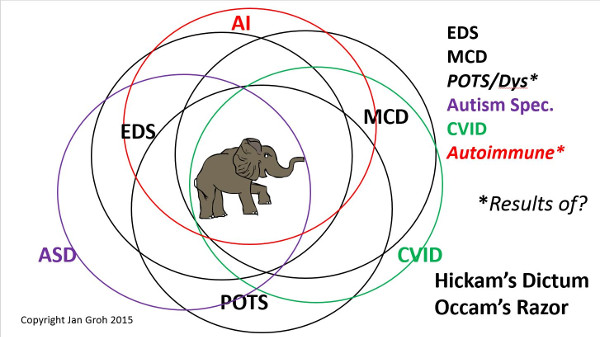
Fasten your seatbelts and settle in with a snack (again), you’re in for a bit of a long ride, smile. I’ll try not to make it too bumpy! (Last updated September 8, 2024.) Hopefully you’ve heard of “The Trifecta” by now – that is, the relatively common trio of issues we find comorbid in the
I really need to include anxiety in this post as well, as the two – depression and anxiety – seem to go very hand-in-hand for a large number of us. No surprise, this is true for the commonly comorbid autism spectrum as well, coincidentally. Maybe we’re finally onto some of the underlying organic causes of
You may have noticed I don’t give much dietary advice here. In fact, to this point, I’ve given virtually none. And this is for a very good reason: just like medications and just about everything else with Ehlers-Danlos Syndrome with a dose of Mast Cell Activation Disorder on the side (any flavor) among plenty of