Neuro-EDS: A new phenotype described July 2026
Although I’m a bit behind updating my blog here, the EDS world has been abuzz since the introduction of what folks are describing as a new phenotype of EDS: Neuro-EDS. That is, a description of a collection of neurological issues involving the cranio-cervical junction, spine and more that seem to plague a notable number of hEDS, HSD and EDS patients as first observed by leading US neurosurgeon Dr. Paolo Bolognese and his wife, pediatrician Dr. Allison R. Bloom.
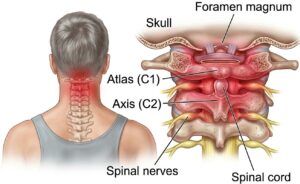
Neuro-EDS is NOT a new type of EDS to be clear! You cannot be diagnosed with Neuro-EDS. Almost no doctors have even heard of it yet – it was just barely introduced as an observatioon in July 2026. But it may help to explain a lot of your troubles if you share a lot of the issues they include, which has been very validating for many of us who do. And, it may potentially lead to some additional genetic or biomarkers some day to help explain this cluster of symptoms in so many patients. Some day. Maybe. The pre-print hasn’t even been peer-reviewed, and no studies conducted yet. Just clinical and data observations made.
As the authors state in their position paper:
“This proposal is intended to complement—not replace—existing diagnostic frameworks (24). Rather than defining a new disease entity, Neuro-EDS offers a systematic approach to identifying, characterizing, and studying a clinically meaningful subgroup within the broader spectrum of heritable connective tissue disorders.”
Further, they suggest two main domains under which to categorize the issues: Craniospinal, and Neurological-Inflammatory-Autoimmune.
The Craniospinal domain includes things like:
- Cranio-cervical instability (CCI)
- Chiari Malformations
- Syryngo-myelia (Syrinx)
- CSF pressure issues (high and low)
- CSF Leaks
- Tethered cord
- Eagle syndrome
That is, things that tend to land in Dr. Bolognese’s office.
The Neuro-Autonomic-Inflammatory Domain includes things like:
- Dysautonomia (all types)
- POTS (a common type of dysautonomia in the population) and other orthostatic intolerances
- GI dysmotility (fast or slow)
- Temperature dysregulation
- Urinary dysfunction
- Mast Cell Activation Syndrome (MCAS)
- Small Fiber Neuropathy
- Neuropathic pain
- Chronic fatigue and ME/CFS-like presentations
That is, things that seem to come with the other list a lot, which Dr. Bolognese and others see a lot. The above lists are not comprehensive. See the pre-print for the complete series. And my long-time followers will recognize all the above as being part of both what I called the Chronic Constellation back in 2016, as well as listed on both my When Else to Suspect and Common Comorbidities pages years ago. It’s nice to see doctors catching on to some of these clusters of issues, and how they do often travel together. (Not all of us will have all of these to be clear.)
For now it is merely a description of a collection of physical characteristics that some EDS and HSD patients may share. Dr. Bolognese and his wife, Dr. Bloom co-presented this finding from clinical observations they had made over the years. They noticed this constellation of issues involving cranial-cervical instability and related neurological issues and other symptoms after seeing many patients over many years. They presented this observation (not a study) at the 2026 EDS Global Learning Conference in Texas, USA in July 2026.
Enough hubbub ensued that they quickly issued a pre-print of a position paper describing Neuro-EDS, but it is still undergoing peer-review. And again, it is NOT a diagnosis, or new type of EDS. Nor even a proper study yet. It is merely a collection of findings they see a lot in their practice as doctors who often see EDS and HSD patients. That is, a clinical observation and description only.
(Aside: I was pleased to hear in the Conference replays that the neurosurgeons are seeking different diagnostic criteria and standards for hypermobile patients than “normies”, since our bodies behave so differently than expected, even in the absence of trauma, the usual reason folks see neurosurgeons. Lending to us being missed and gaslit.)
Again, you cannot be diagnosed with this. But it may provide a valid hook on which to hang a lot of your issues if this describes you, diagnosed or not. Or a sort of shorthand. And it may lend to additional helpful studies which may find some biological clues as to why this all seems to travel together in some of us.
For further reading I recommend these two great articles:
What is Neuro-EDS by David Harris of EDS.clinic updated September 2026
What Is “Neuro-EDS” and Why Are People Talking About It? by Jacqueline Teti, Editor-in-Chief CPP Agust 2026


About The Author
